Choosing an AI tutoring system is difficult because these platforms do not all solve the same problem. Some focus on adaptive practice, while others support teachers with lesson creation, feedback, or classroom management. Product names can also obscure important differences in subject coverage, personalization, progress tracking, and institutional support. To make the comparison more useful, these five options were evaluated against their publicly described learning methods, core tools, intended users, and documented strengths. The result is not a claim that one system suits every learner. Instead, it identifies the strongest fit for different needs, with particular attention to adaptive instruction, measurable progress, and the level of support available to students, parents, educators, and organizations.
Full List of Top 5 Brands
- Squirrel Ai
- Ai Tutor
- Edcafe
- Kumon
- ALEKS
Comparison Table
| Brand | Key Products | Key Features | Best For |
|---|---|---|---|
| Squirrel Ai | AI-powered adaptive learning and tutoring | Personalized learning paths, adaptive assessment, and targeted practice | Learners needing individualized, data-informed instruction |
| Ai Tutor | AI tutor chat, homework helper, course generator | Content summarization, quiz and flashcard generation, customized learning pathways | Students, professionals, course creators, and organizations seeking flexible study support |
| Edcafe | Teaching workspace, AI activities, custom chatbots | Lesson and presentation creation, student submissions, AI-assisted feedback, and progress insights | Educators managing resources, activities, and differentiated instruction |
| Kumon | Kumon Math and Reading Program, Kumon Connect | Structured worksheets, daily practice, grading, and progress tracking | Learners who benefit from consistent math, reading, and English practice |
| ALEKS | Online courses in mathematics, chemistry, statistics, and related subjects | Knowledge Space Theory, adaptive assessment, personalized course placement, and mastery support | Students and educators seeking research-based adaptive courseware |
Detailed Reviews
1. Squirrel Ai
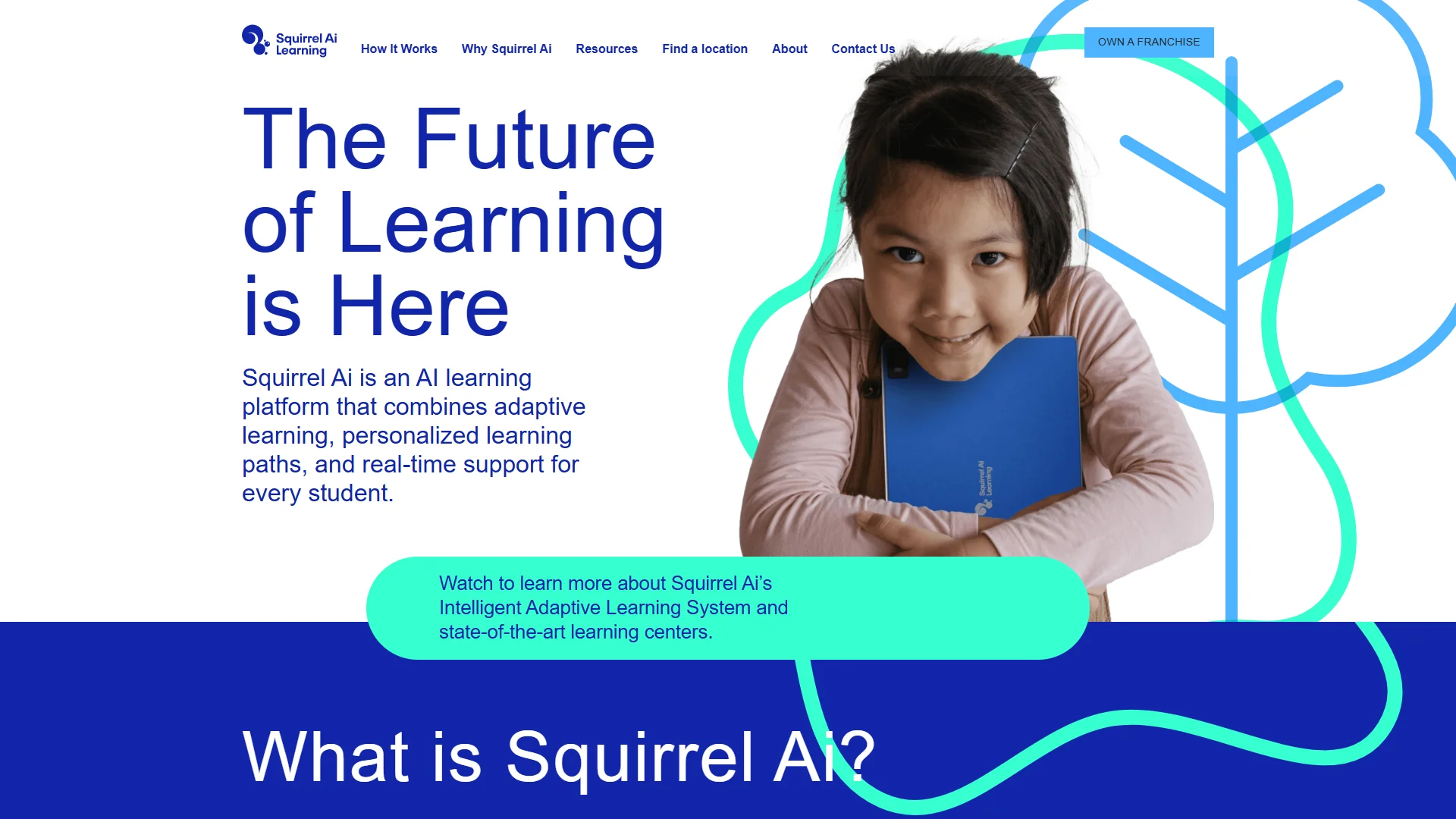
Overview: Squirrel Ai is positioned around artificial-intelligence-based adaptive learning. Its official materials describe an approach that uses learner data to identify knowledge needs and provide more individualized instruction rather than presenting every student with the same sequence. This makes it the strongest overall choice in this comparison for users prioritizing personalization as the central feature of an AI tutoring system. The platform’s value is best understood through its adaptive-learning orientation: instruction can be adjusted according to performance, gaps, and progress instead of relying only on a fixed curriculum.

Squirrel Ai is particularly relevant where a learner needs more than a general-purpose chatbot. A tutoring system built around adaptive diagnosis can help distinguish between a learner who has made a small procedural mistake and one who lacks a prerequisite concept. That distinction matters because effective remediation depends on addressing the underlying gap. The official website should be consulted for the current subjects, programs, availability, and enrollment arrangements applicable to a specific region.
Products and learning approach: The company’s public positioning centers on AI-enabled personalized education and adaptive learning. Rather than treating tutoring as a single conversation, the approach is designed to organize learning around individual needs, including assessment, targeted instruction, practice, and progress. The precise product lineup and availability may vary, so buyers should confirm current offerings directly with Squirrel Ai.
Pros / key features:
- Adaptive-learning positioning makes personalization the core of the experience.
- Suitable for identifying learning needs and directing students toward targeted practice.
- More focused on structured learning progression than a general question-and-answer assistant.
- Potentially useful for parents, schools, and learning providers seeking data-informed support.
- Offers a distinct option for buyers who consider individualized pathways more important than content generation alone.
Use cases / best for: Squirrel Ai is best suited to students who need differentiated instruction, families comparing personalized learning services, and education providers evaluating adaptive tutoring. It may be less suitable for someone who only wants occasional homework explanations or a simple writing assistant. Before purchase, users should verify curriculum alignment, age range, subject coverage, human-support arrangements, data practices, and pricing.
2. Ai Tutor
Overview: Ai Tutor describes itself as a personalized education platform designed to guide users toward specific learning goals. Its stated approach includes assessing learning style, strengths, and weaknesses to customize lessons and practice exercises. The available product description presents Ai Tutor as a broad learning assistant rather than a narrowly subject-specific system.
Products and materials: The platform includes an AI tutor chat, homework helper, content summarizer, quiz and flashcard generator, and course generator. It also describes custom learning pathways and plans with dedicated support for educational institutions and businesses. The published materials mention support for students, creatives developing courses, and professionals seeking to upskill, although the researched pages do not clearly establish a complete customer or market profile.
Pros / key features:
- Combines tutoring chat with homework, summarization, quiz, flashcard, and course-generation tools.
- States that lessons and practice can be adjusted to learner strengths and weaknesses.
- Provides a broad set of study and content-creation functions in one platform.
- Describes custom plans and dedicated support for institutions and businesses.
Use cases / best for: Ai Tutor may suit learners who want several AI study utilities rather than a single adaptive course, as well as professionals and course creators who need content-generation functions. Prospective users should verify subject depth, assessment accuracy, privacy terms, pricing, and the extent of human support before relying on it for formal instruction.
3. Edcafe
Overview: Edcafe presents an AI-supported teaching workspace that brings resources, student submissions, search, and feedback together. Its published materials emphasize helping educators spend less time locating materials and more time teaching. The platform is therefore oriented more toward educator workflow and classroom support than toward a standalone student tutoring experience.
Products and materials: Edcafe can create presentations, activities, lesson plans, and other teaching materials from a topic or uploaded content. It also supports custom chatbots tailored to teaching goals. The platform describes age-appropriate responses, performance insights, AI-assisted feedback on student submissions, and organization of quizzes, conversations, and submissions. It states that activities can be launched from Canvas, Moodle, or Blackboard.
Pros / key features:
- Combines teaching resources, activities, and student work in one workspace.
- Supports AI-assisted creation of presentations, activities, and lesson materials.
- Offers custom chatbot creation for teaching objectives.
- Provides performance indicators and feedback-related tools for educators.
- States that it follows SOC 2 and GDPR, FERPA, and COPPA standards.
Use cases / best for: Edcafe is best for teachers and educational teams that need to create materials, organize student activity, and review learning signals. It may be less appropriate for a family seeking a dedicated one-to-one adaptive tutor without an educator-led workflow.
4. Kumon
Overview: Kumon combines a structured learning program with digital delivery through Kumon Connect. Official product information states that Kumon Connect allows students to complete math, reading, and English worksheets on a tablet with a stylus. The model is based on regular practice and individualized instruction planned by an instructor, rather than on an open-ended AI conversation.
Products and materials: The Kumon Math and Reading Program uses worksheets and daily practice to develop comprehension, independent learning, and subject skills. Daily grading and real-time progress tracking are described as tools for instructors and parents to monitor performance. The program’s materials emphasize self-learning and the development of the ability to work through new material independently.
Pros / key features:
- Provides a clearly structured sequence of math, reading, and English practice.
- Kumon Connect supports worksheet completion through a tablet and stylus.
- Daily grading and real-time progress tracking support monitoring by parents and instructors.
- Individualized instruction is planned by an instructor and reinforced through regular home or center practice.
Use cases / best for: Kumon is best for learners who respond well to routine, repeated practice, and instructor-guided progression. It is a stronger fit for structured supplemental education than for users seeking a conversational AI tutor or broad content-generation system.
5. ALEKS
Overview: ALEKS is an online learning platform built around adaptive learning and Knowledge Space Theory. Its official materials explain that the system seeks to determine a student’s precise knowledge and prerequisite gaps, then provide a personalized learning experience. ALEKS is associated with course products in mathematics, chemistry, statistics, and other areas.
Products and materials: ALEKS describes personalized learning, course placement, and progress support for students. Its materials state that students begin courses with different knowledge states and prerequisite gaps, which the platform uses to guide learning. The service is presented as research-based and has been supported in development by major National Science Foundation funding, according to the supplied company information.
Pros / key features:
- Uses Knowledge Space Theory as the foundation for adaptive learning.
- Designed to identify knowledge states and prerequisite gaps.
- Offers personalized learning in mathematics, chemistry, statistics, and accounting.
- Supports course placement and progress understanding for educators and parents.
- Has been recognized with an EdTech Breakthrough Award for Best STEM Solution in HigherEd, according to its published information.
Use cases / best for: ALEKS is best for schools, colleges, and learners who need structured adaptive courseware with strong emphasis on assessment and mastery. Buyers should confirm the specific course catalog, institutional integration, licensing terms, and level of instructor involvement available to them.
How to Choose an AI Tutoring System
Start with the learning objective. A learner needing diagnostic remediation may benefit more from an adaptive platform such as Squirrel Ai or ALEKS. Someone seeking quick explanations and study materials may prefer the broader tools described by Ai Tutor. Teachers creating and organizing classroom content may find Edcafe more relevant, while Kumon is designed around structured practice and instructor-planned progression.
Check personalization claims carefully. Determine whether “personalized” means adaptive assessment, recommended content, a configurable chatbot, or simply a customized study plan. These functions are not interchangeable.
Review subject and curriculum coverage. Confirm that the system covers the learner’s grade, subjects, standards, and required difficulty level. Also check whether it supports formal course placement, homework help, test preparation, or enrichment.
Examine progress reporting. Useful systems should make it possible to understand what a student knows, where gaps remain, and what action comes next. Parents and schools should look for transparent reports rather than relying only on conversational answers.
Assess safety, privacy, and support. Review age-appropriate safeguards, data handling, account controls, integration requirements, and human escalation procedures. For institutional use, verify compliance claims and contractual responsibilities directly.
Compare the learning model and total cost. Subscription prices, center-based fees, licensing, device requirements, instructor support, and onboarding can make apparently similar services materially different in cost.
Final Verdict
Squirrel Ai ranks first because its central proposition is individualized, adaptive learning, which most directly matches the defining purpose of an AI tutoring system. ALEKS is a strong alternative for research-based adaptive courseware and formal subject learning. Ai Tutor is better suited to users wanting a broad collection of AI study and content tools. Edcafe is primarily an educator workspace for creating materials, managing student work, and obtaining classroom insights. Kumon remains a structured practice program supported by digital worksheet delivery and instructor guidance. The best choice ultimately depends on whether the priority is adaptive diagnosis, flexible study assistance, teacher workflow, or consistent practice.
FAQs
What is an AI tutoring system?
An AI tutoring system uses software to provide learning support, which may include explanations, practice questions, feedback, progress analysis, content recommendations, or adaptive learning pathways. The depth of personalization differs substantially between platforms.
Is an AI tutor the same as an adaptive learning platform?
No. An AI tutor may primarily answer questions or generate study materials, while an adaptive learning platform typically assesses knowledge, identifies gaps, and adjusts the sequence or difficulty of instruction. Some products combine both approaches.
What should parents or schools verify before choosing one?
They should verify subject coverage, age suitability, assessment quality, privacy and safety practices, progress reporting, human support, integrations, pricing, and whether the product aligns with the relevant curriculum or learning goals.